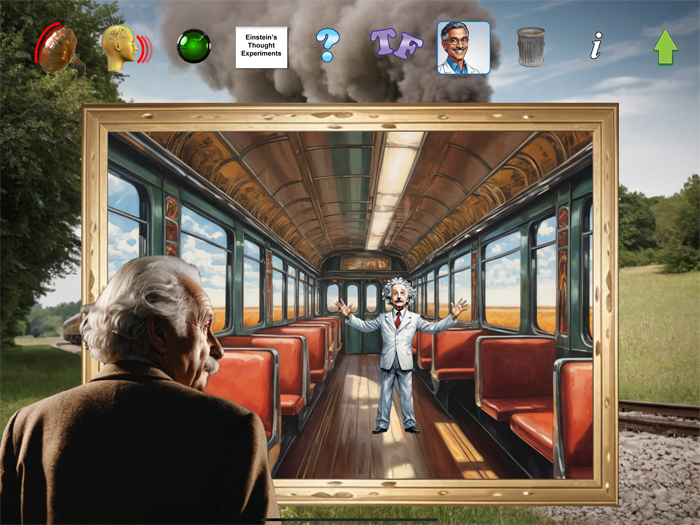
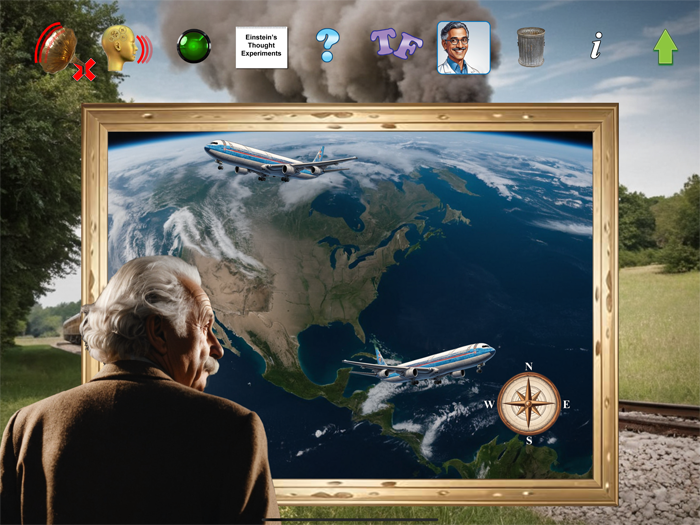
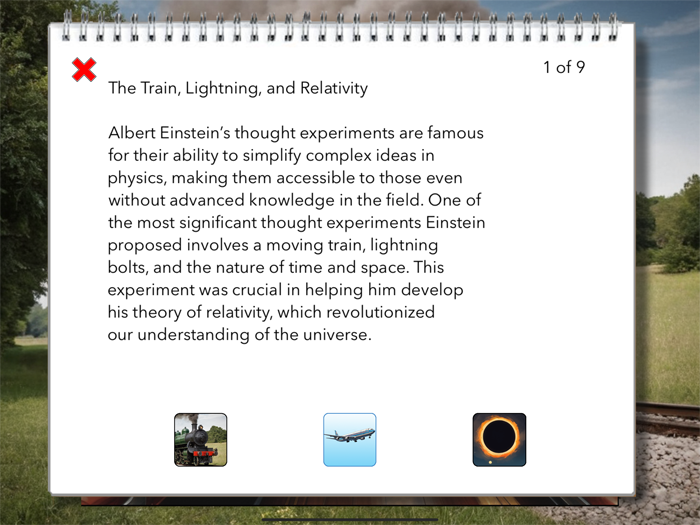
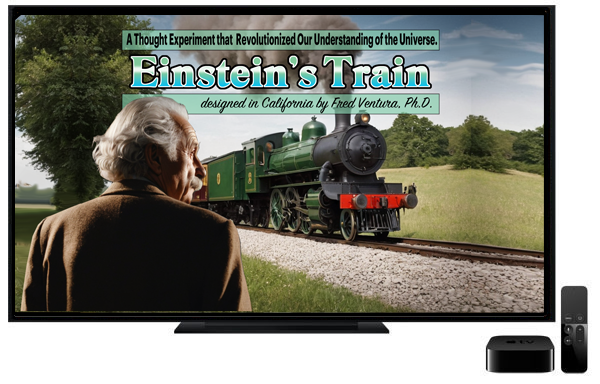
Dive into the world of relativity with Einstein's Train, an engaging educational app designed to make one of Einstein's most famous thought experiments accessible and exciting for high school students. This app combines dynamic graphics, interactive text, and challenging quizzes to explore the profound implications of Einstein's famous thought experiment and its role in the development of general relativity.
Key Features:
-
Interactive Visuals: Explore the concept of space-time through stunning, dynamic graphics. Watch as a lightning strike challenges the notion of simultaneity, learn about Dyson and Eddington's expedition to test Einstein's theory, bends space-time, and be fascinated by Hafele and Keating's experiment that revealed the concept of time dilation..
-
Engaging Text: Written at a high school reading level, the app provides clear, concise explanations of complex concepts. Understand how Einstein's thought experiment challenged existing ideas about general relativity and led to groundbreaking changes in physics.
-
Quizzes and Challenges: Test your knowledge with multiple-choice and true/false quizzes after each section. Each quiz is designed to reinforce key concepts, helping students to grasp and retain the material.
-
Cross-Platform Availability: Whether you’re on the go with your iPad or enjoying a learning session on your Apple TV, Einstein's Train is optimized for both iOS and tvOS.
-
Progress Tracking: Keep track of your learning progress, revisit challenging sections, and aim for a perfect score on every quiz.
Learning Outcomes: By using Einstein's Train students will:
- Understand the significance of Einstein's Train thought experiment.
- Learn how the experiment contributed to the development of the theory of general relativity.
- Grasp the concepts of space-time curvature the bending of light.
- Strengthen their knowledge through interactive content and quizzes.
Join the journey through space-time and discover how a simple train ride changed our understanding of the universe!
Why Our App Stands Out:
• Interactive Simulations: Einstein's Train in action with hands-on simulations that bring this thought experiment to life. Watch how the perception of simultaneity can be challenges with a clever thought experiment.
• Engaging Lessons: Our app breaks down complex scientific concepts into easy-to-understand lessons. Learn about gravity, spacetime, time dilation, bending light rays and more. The app explains how tought experiments are useful tools for physicists. Einstein's thought experiments had the significance of opening the door to the discovery of general relativity..
• Quizzes and Challenges: Test your knowledge with interactive quizzes and challenges designed to reinforce learning. Earn certificates as you progress through the app.
Who Is It For?
Our app is perfect for students, educators, and science enthusiasts of all ages. Whether you're a high school student exploring advanced physics, a teacher looking for engaging classroom resources, or simply curious about the wonders of the universe, our app offers a comprehensive and captivating learning experience.
Download Now and Start Your Journey!
Don't miss out on this opportunity to deepen your understanding of general relativity and physics. Download our app today and embark on a journey through the fascinating world of Einstein's Train and beyond. Discover how a simple idea about riding in an train during a lightning storm can lead to big discoveries and helped to unravel the mysteries of the universe with our cutting-edge educational tool!
Available exclusively for iOS and tvOS devices.
Check out our new Augmented Reality Apps!
Giants of Math and Science Series:
Ada Lovelace • The First Coder
Albert Einstein • Theoretical Physicist
Archimedes • Mathematician • Inventor
Aristotle • Ancient Greek Philosopher
Blaise Pascal • Mathematician • Scientist • Philosopher
Bonaventura Cavalieri • Mathematician
Carl Gauss • Physicist, Mathematician, Astronomer
Ceclia Payne • Stellar Astronomer • Astrophysicist
Charles Darwin • The Science of Evolution
Chien-Shiung Wu • Particle Physicist
Dorothy Crowfoot Hodgkin • Biological Chemist
Ernest Rutherford • Nuclear Physicist
Euclid • The Father of Geometry
Galileo Galilei • The Father of Modern Science
Gregor Mendel • Botanist
Isaac Newton • Mathematician • Physics • Astronomy
James Clerk Maxwell • Physicist • Mathematician
Johannes Kepler • Astronomer • Mathematician
Leonard Fibonacci • Mathematician
Leonhard Euler • Mathematician
Lise Meitner • Nuclear Physicist
Louis Pasteur • Microbiologist • Chemist
Marie Curie • Physicist and Chemist
Michael Faraday • Chemist • Physicist
Nicolaus Copernicus • Astronomer
Pythagoras • Mathematician • Philosopher
Rachel Carson • Environmental Scientist
René Descartes • Philosopher & Mathematician
Rosalind Franklin • Chemist & Molecular Biologist
Sofia Kovalevskaya • Mathematician |